

EXPLORE THE WHAT-IF
What would happen — and when?
This is a deliberately impossible thought experiment. Use the controls to follow what Earth might experience if the Sun suddenly stopped providing its normal light and heat.
Choose a scenario
Compare the hypothetical with the Sun's real scientific future.
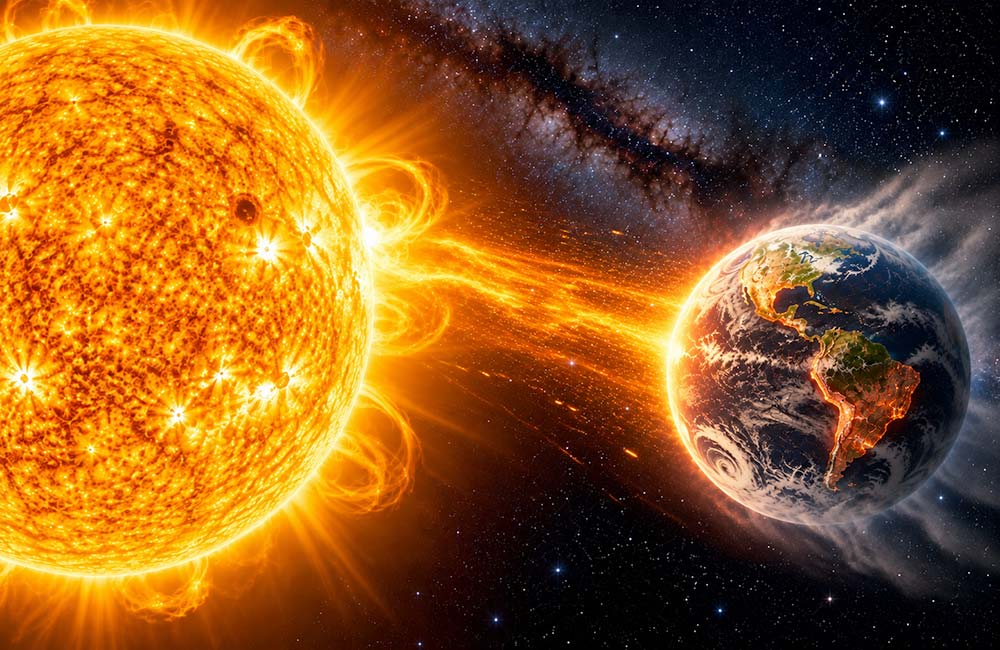
About 8 minutes later
Earth finally notices
For roughly the first eight minutes, everything would appear normal because the sunlight already travelling toward Earth would still be arriving.
This interactive is a simplified thought experiment, not a prediction. The real Sun will not suddenly disappear or explode as a supernova.
THE FIRST SURPRISE
Why wouldn't we know immediately?
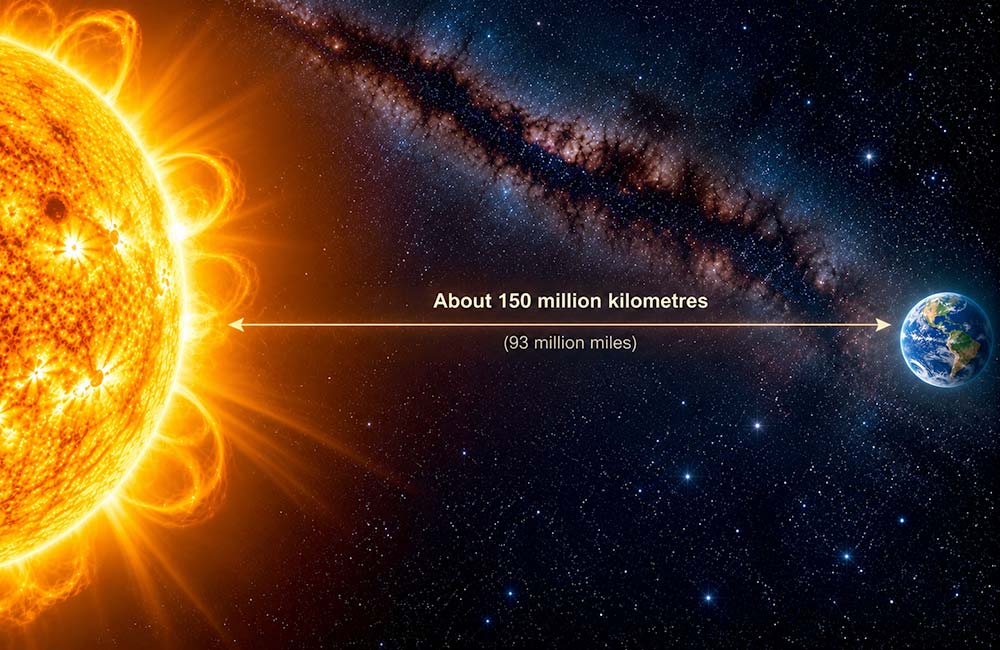
Earth is about 150 million kilometres (93 million miles) from the Sun. Light does not cross that distance instantly: it takes roughly 8 minutes 20 seconds.
That means if something impossible happened to the Sun right now, the sunlight already in transit would continue reaching us for those final minutes.
THE CHAIN REACTION
What would happen to Earth?
Losing the Sun's energy would not make Earth freeze solid in an instant. The planet, oceans and atmosphere store enormous amounts of heat. But without incoming solar energy, the direction would be one-way: darker and colder.
Nothing looks different
- Sunlight already in transit keeps arriving.
- Surface temperatures barely change.
- Plants continue photosynthesising briefly.
- Daily life initially appears normal.
Daylight disappears
- The Sun vanishes from the sky in the thought experiment.
- Photosynthesis stops without sunlight.
- Solar heating ends.
- Artificial light becomes the only local illumination.
The planet cools
- Surface temperatures continue falling.
- Plants and food webs come under severe stress.
- Heating and energy become critical to survival.
- Ice begins spreading across exposed water.
Surface survival becomes extreme
- Most familiar ecosystems collapse.
- Large areas of the ocean develop surface ice.
- Geothermal and artificial energy become increasingly important.
- Any surviving communities would need highly protected environments.
These stages are intentionally broad. Earth's climate is complex, and exact temperatures and survival times would depend on many interacting processes. The slider is designed to show the direction and sequence of consequences rather than pretend there is a precise countdown.
GOING DEEPER
Could anything survive?
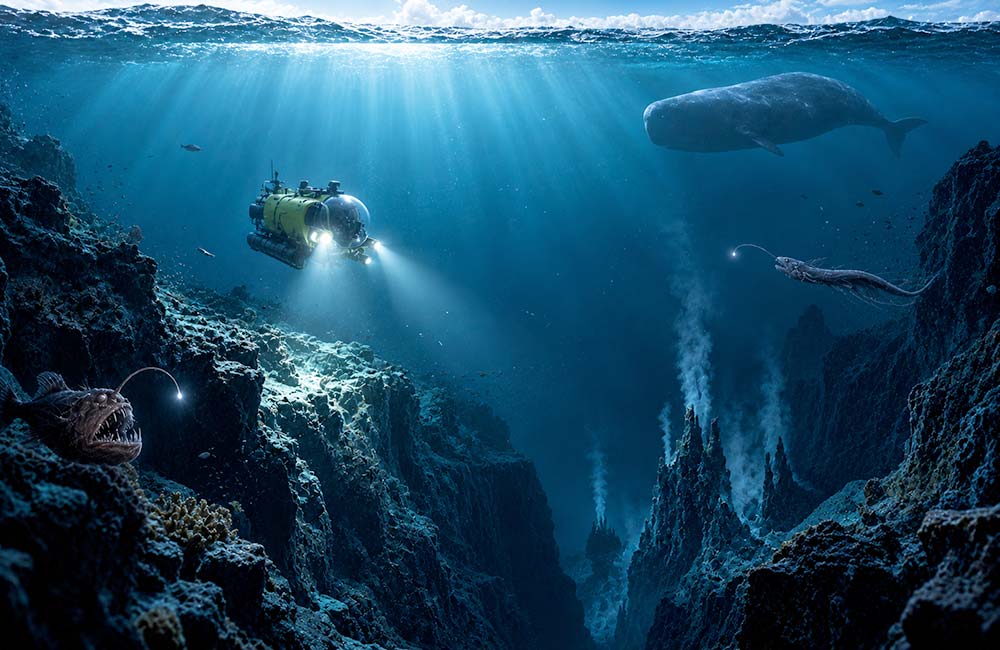
Surface ecosystems depend heavily on sunlight, but not every organism gets its energy directly from the Sun. Some ecosystems around deep-sea hydrothermal vents are powered by chemical energy, while the Earth's interior would continue releasing geothermal heat.
Earth's surface
The hardest place to remain
The surface would lose its main source of light and heat. Plants would lose the sunlight needed for photosynthesis, temperatures would fall and familiar food webs would unravel.
WHAT SCIENCE ACTUALLY SAYS
What will really happen to the Sun?
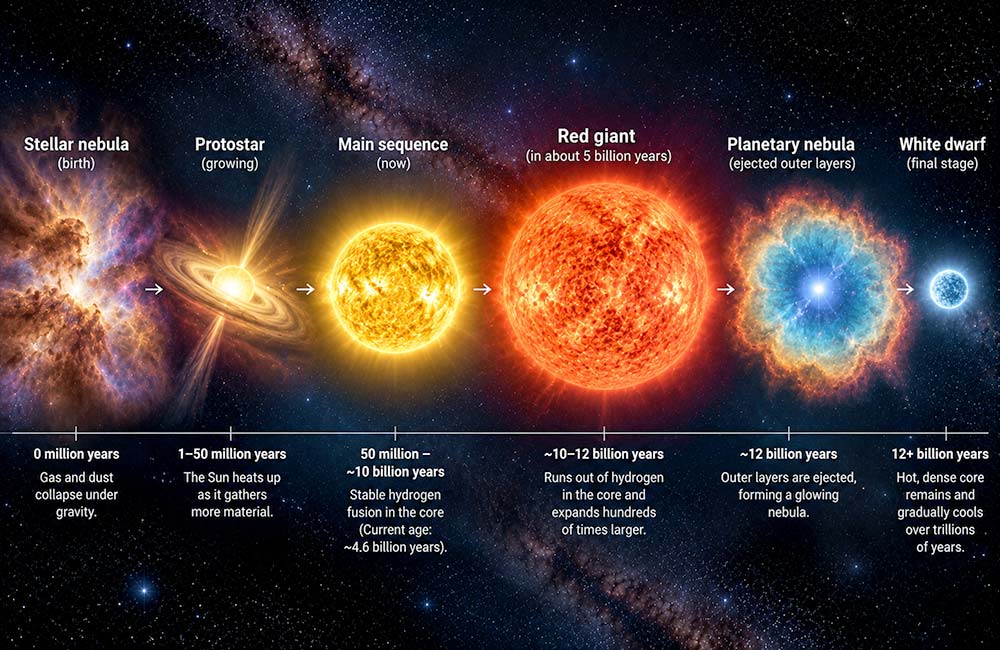
The dramatic answer is much slower than an explosion. The Sun is a middle-aged, Sun-like star. It has been shining for about 4.6 billion years and is expected to continue its present main-sequence life for roughly another 5 billion years.
Today, nuclear fusion in the Sun's core converts hydrogen into helium. Eventually the usable hydrogen in the core becomes depleted. The core contracts and heats while hydrogen fusion continues in a surrounding shell, causing the Sun's outer layers to expand.
Today — about 4.6 billion years old
The Sun is still on the main sequence
Hydrogen fusion in the core supplies the energy that supports the Sun and provides Earth with light and heat. The Sun is roughly halfway through this long stage of its life.
EARTH'S DISTANT FUTURE
Will the expanding Sun swallow Earth?
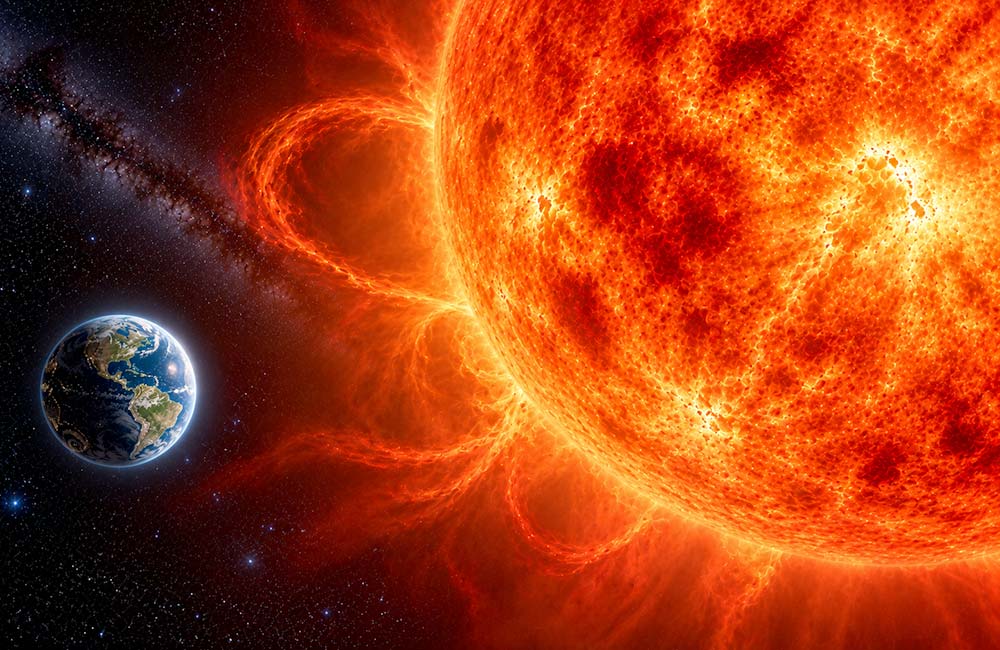
The Sun's red-giant phase will radically transform the inner Solar System. Mercury and Venus are expected to be engulfed. Earth's exact fate is more complicated in some scientific descriptions because the Sun will also lose mass, allowing planetary orbits to move outward.
But there is no comfortable escape for Earth in either case. Long before the Sun reaches its maximum red-giant size, its increasing brightness will make our planet progressively hotter and eventually uninhabitable.
So is Earth definitely swallowed?
It is safer to distinguish the certainty from the uncertainty. Earth will become uninhabitable as the Sun brightens. Whether the later red giant physically engulfs Earth is treated with some uncertainty in current scientific descriptions, although NASA sources often describe it as possible or expected depending on the model.
THE REAL TIMELINE
When will all this happen?
Not on any human timescale. The important numbers are measured in billions of years.
The Sun is about 4.6 billion years old and remains a main-sequence star.
Core hydrogen becomes depleted and the Sun evolves toward its red-giant phase.
The Sun expands enormously and the inner Solar System is transformed.
The Sun sheds its outer layers, leaving its hot core behind as a white dwarf.
Stellar-evolution times are approximate rather than appointments on a calendar. The important conclusion is that the Sun's transformation is a gradual process taking place billions of years from now.
Bottom Line
The Sun is not going to explode as a supernova. If it somehow vanished or stopped supplying Earth with energy, we would have about eight minutes before seeing the change, followed by a long collapse of the warm, sunlit environment that supports most life.
The real ending is slower and more interesting: billions of years from now the Sun will exhaust hydrogen in its core, swell into a red giant, shed its outer layers and leave behind a dense white dwarf.
Scientific sources
The astronomy on this page is based primarily on current educational material from NASA and the European Space Agency.