

EXPLORE THE WHAT-IF
How much difference does each kind of ice make?
“All the ice” sounds like one simple scenario, but the location of the ice matters. The huge ice sheets on Greenland and Antarctica sit mainly on land, while Arctic sea ice already floats in the ocean. Use the controls below to compare them.
Choose an ice-loss scenario
Compare the broad sea-level effect of different stores of ice.
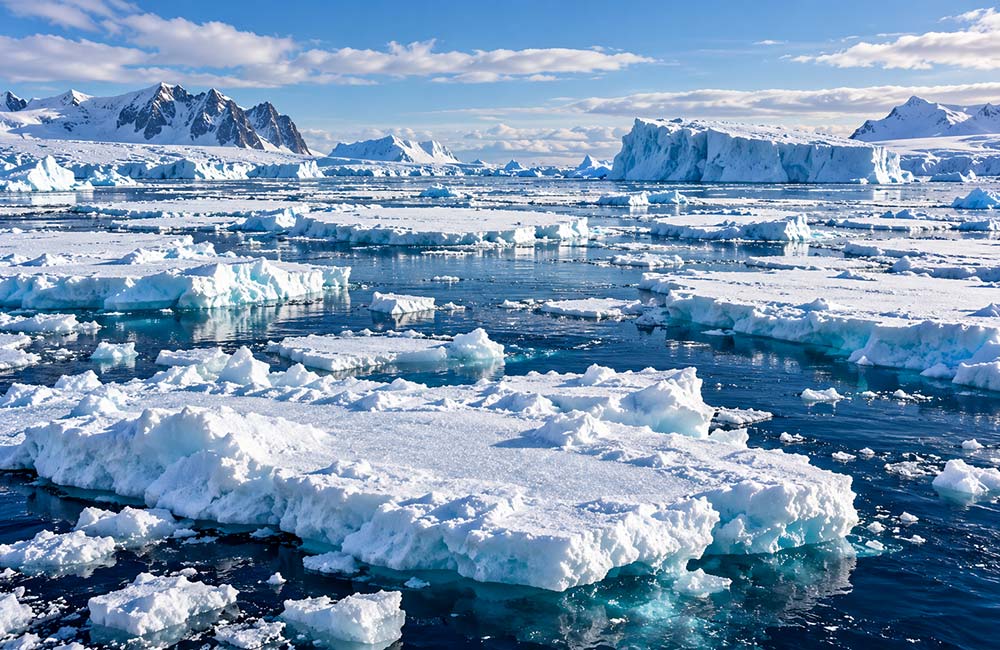
FLOATING SEA ICE
Little direct sea-level rise from melting itself
Floating ice already displaces seawater. When it melts, it does not add anything like the sea-level rise produced by melting land ice.
These figures are simplified global-mean equivalents. Actual local sea-level change would vary by region because of gravity, land movement, ocean circulation and other effects.
THE KEY DIFFERENCE
Land ice and sea ice are not the same
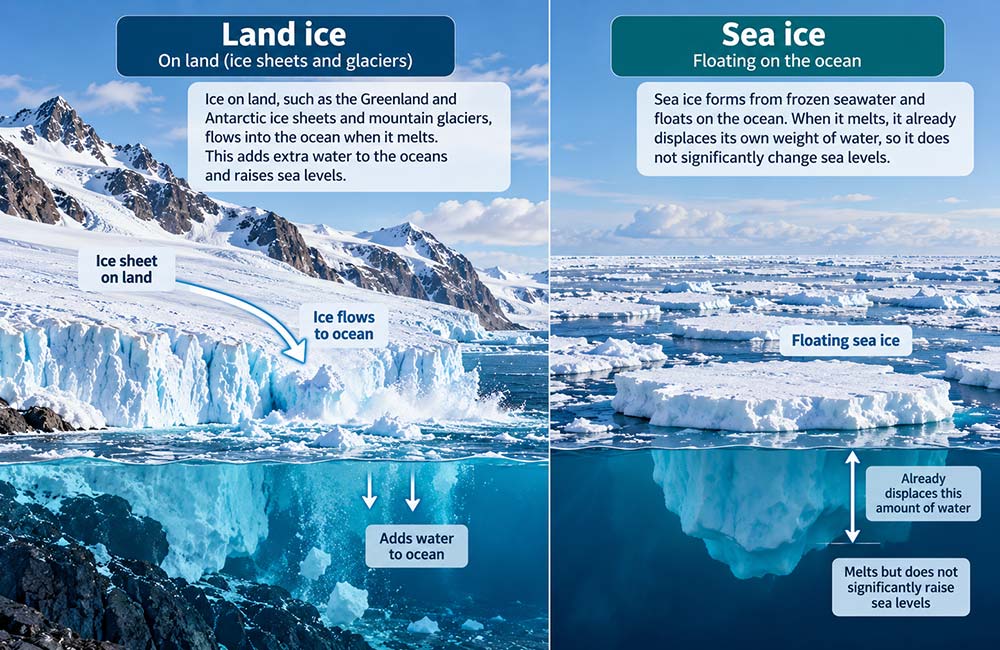
A glacier or ice sheet resting on land stores water outside the ocean. When that ice melts and the water reaches the sea, ocean mass increases. Floating sea ice is already in the ocean and already displaces water.
Land ice
Greenland, Antarctica and mountain glaciers hold water on land. Their loss adds water to the ocean and raises sea level.
Floating sea ice
Sea ice floats and already displaces seawater. Its melting has only a very small direct effect on global sea level.
RISING WATER
What would a 70-metre sea-level rise mean?
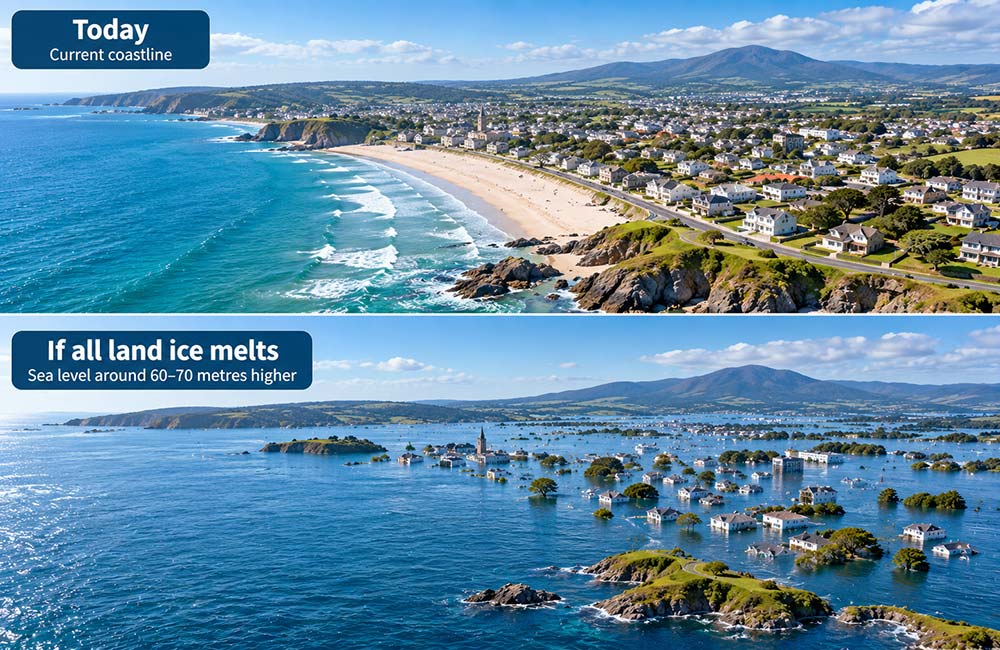
USGS estimates that melting all glaciers and ice caps would raise global sea level by approximately 70 metres, or about 230 feet. That does not mean every shoreline would simply move inland by the same distance. Coastal shape, elevation, river valleys and local land movement would determine where the water reached.
INTERACTIVE SEA LEVEL
Move through a simplified rise in global mean sea level
TODAY
Present-day coastline
This is the starting point. Even much smaller rises than 70 metres can greatly increase coastal flooding and erosion.
COASTLINES & CITIES
Many coastal regions would be transformed
At the extreme end of this thought experiment, low-lying deltas, coastal plains and many present-day waterfront districts would be below the new mean sea level. Some cities would lose large areas; others sit partly on higher ground and would change shape rather than disappear entirely.
Rivers would meet the sea farther inland, estuaries would expand, and salt water could move into areas that are fresh water or dry land today. Ports, roads, railways, airports and other infrastructure concentrated near current coastlines would have to be relocated on an enormous scale.
Shorelines move inland
Low coastal plains and deltas are especially exposed to large changes in sea level.
Estuaries expand
River mouths and tidal zones would migrate as the ocean occupied lower terrain.
Ports and transport move
Much of today’s coastal infrastructure is built for the present shoreline.
Saltwater reaches farther inland
Freshwater systems near coasts could face major changes as marine water advances.
A DIFFERENT PLANET
Losing the ice would change more than coastlines
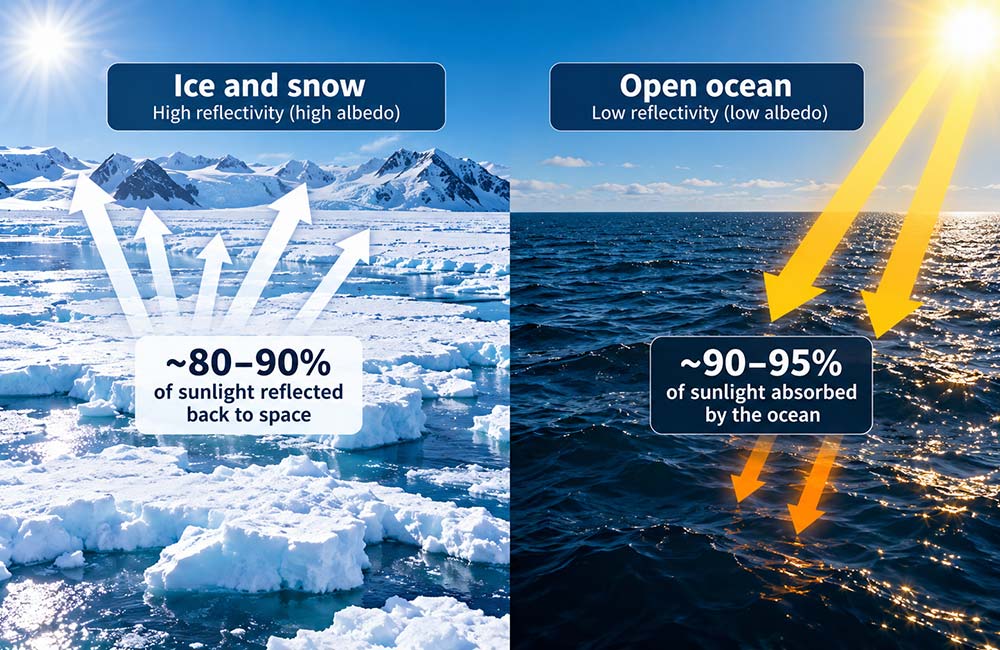
Bright snow and ice reflect a large share of incoming sunlight. Replacing reflective ice with darker ocean or land allows more solar energy to be absorbed, reinforcing warming. Loss of ice also changes polar habitats and can alter the exchange of fresh water and heat within the ocean.
The exact climate response to a nearly ice-free Earth would depend on how and over what timescale the ice disappeared. That is one reason this page treats total melt as a thought experiment rather than a single forecast with a precise date.
A NEW WORLD MAP
Which places would be underwater?
A rise of around 70 metres (230 feet) would transform the world's coastlines, but it would not simply cover every coastal country with water. Elevation matters. Mountainous and high-lying areas would remain above sea level, while low coastal plains, river deltas and existing floodplains would be affected much more severely.
Large parts of Florida, for example, are relatively low-lying and would be dramatically reshaped. The Netherlands would lose extensive areas of land without its present system of coastal defences. Low-lying parts of Bangladesh and major river deltas around the world would also be particularly vulnerable.
Cities such as London and New York would change enormously, but saying that every part of these cities would simply disappear would be misleading. Higher ground would remain above water while today's lower districts, waterfronts, transport systems and surrounding lowlands could lie beneath the new shoreline.
Sea-level rise is measured vertically from the existing ocean surface. How far the coastline moves inland depends on the height and shape of the land. On a steep rocky coast the shoreline might move relatively little, while across a flat coastal plain it could move many kilometres.
HUMAN SURVIVAL
Would humans survive if all the ice melted?
Yes. Even a world with no major land ice would still contain enormous areas of habitable land well above the new sea level. The scenario would therefore be very different from an event that made Earth completely uninhabitable.
The real problem would be the scale of the disruption. Many of today's largest cities, ports, industrial areas and transport networks have developed close to the coast. Losing those areas would mean relocating populations and rebuilding infrastructure on a scale unlike anything in human history.
The effects would extend far beyond flooded buildings. Agricultural land could be lost, freshwater supplies near the coast could become contaminated by salt water, and roads, railways, power networks and ports would have to be reconstructed farther inland.
People would gradually concentrate on higher ground and new cities would develop around the altered coastline. Exactly where populations could live would also depend on the climate of this much warmer world, rainfall patterns, freshwater availability and the suitability of remaining land for agriculture.
THE TIMESCALE
How long would it take for all the ice to melt?
There is an important difference between asking what would happen if all Earth's land ice melted and predicting that it actually will. The roughly 70-metre figure describes an extreme end-state in which essentially all glaciers and the Greenland and Antarctic ice sheets have disappeared. It is not a prediction for this century.
The great ice sheets contain such enormous quantities of ice that their complete disappearance would take a very long time. How quickly they lose mass depends on future temperatures, snowfall, ocean conditions and the way individual parts of the ice sheets respond to warming.
This also means the world's oceans would not suddenly rise by 70 metres. In a real warming scenario, changes would occur progressively, giving coastlines, ecosystems and human societies some time to respond — although even much smaller amounts of sea-level rise can create serious problems for densely populated coastal areas.
The interactive 70-metre scenario helps show how much water is stored in Earth's land ice. It should not be interpreted as a prediction that all of that ice will disappear within a particular lifetime or century.
COULD IT REVERSE?
Could Earth's ice eventually come back?
Earth has moved between colder and warmer periods many times during its history. Given sufficiently cold conditions over long periods, snow can accumulate faster than it melts, eventually compressing into glacial ice. In principle, large ice sheets could therefore grow again.
That would not be a quick reversal. Building an ice sheet kilometres thick requires enormous amounts of snowfall accumulating over very long periods. Once a major ice sheet has disappeared, recreating it would involve climatic changes operating over thousands of years or longer.
There is another complication: losing large areas of bright ice changes how much sunlight Earth absorbs. Ice and snow reflect considerably more solar energy than dark ocean or exposed land. Removing them therefore changes the climate system itself, which is one reason the loss and recovery of major ice sheets cannot be treated like simply freezing and thawing a small body of water.
FRESH WATER
Most of Earth’s freshwater ice is locked in the great ice sheets
Greenland and Antarctica contain more than 99 percent of Earth’s freshwater ice. Their complete melting would account for most of the sea-level rise in this scenario. Mountain glaciers are far smaller in total volume, but they are important regional water stores and their loss can affect rivers and ecosystems far from the coast.
Different scientific sources quote slightly different sea-level equivalents depending on definitions and datasets. For this page, about 70 metres is used as the rounded all-land-ice figure, while Greenland and Antarctica are shown as approximate individual contributions.
WHAT SCIENCE ACTUALLY SAYS
All the ice is not about to disappear
The complete melting of Greenland and Antarctica is not a near-term event. Ice sheets respond over long timescales, and their future depends strongly on future warming. The useful part of the “all the ice melts” question is that it shows how much water is stored on land and why even a fraction of that loss matters to coastlines.
NASA observations show that both Greenland and Antarctica are currently losing ice mass. That ongoing loss contributes to present-day sea-level rise, but it should not be confused with the instant, complete-melt scenario explored here.
BOTTOM LINE
If all land ice melted, coastlines would be redrawn on a planetary scale.
The headline figure is roughly 70 metres (230 feet) of global mean sea-level rise. Most of that potential water is stored in Antarctica and Greenland. Floating sea ice is different: melting it does not directly raise sea level in the same way. The total-melt scenario is an extreme long-term thought experiment, but it makes the importance of today’s much smaller changes easier to understand.