

EXPLORE THE WHAT-IF
What would happen — and when?
There is no realistic mechanism that could stop Earth instantaneously. This interactive separates a sudden-stop thought experiment from a gradual slowdown and from the real rotating Earth.
Choose a scenario
Compare a sudden stop, a gradual slowdown and normal Earth.
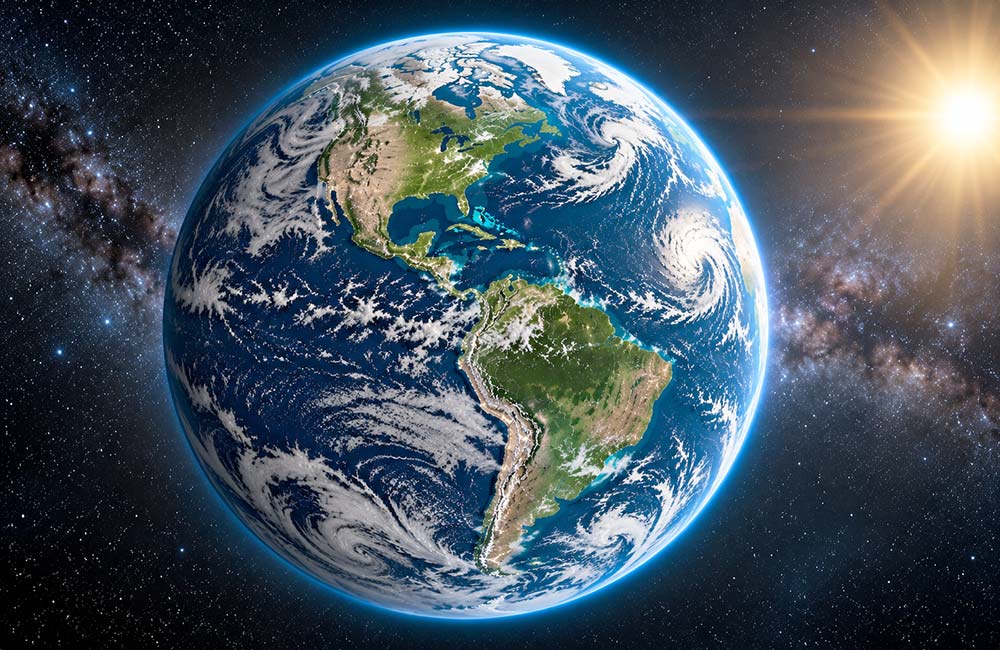
Before the thought experiment
Earth is already moving very fast
Earth completes one rotation relative to the stars in about 23.9 hours. At the equator, that corresponds to roughly 1,670 km/h of eastward surface motion.
This is a simplified, impossible thought experiment designed to illustrate momentum and the importance of rotation. It is not a prediction.
YOU ARE MOVING RIGHT NOW
How fast is Earth actually spinning?
A point on the equator travels the greatest distance during each rotation, so it has the highest eastward surface speed. The speed falls with latitude and reaches essentially zero at the rotational axis.
Rotation speed by latitude
Choose a latitude to compare the eastward speed retained in the sudden-stop thought experiment.
Equator
~1,670 km/h · ~1,040 mphThe maximum surface speed: the immediate momentum problem would be most extreme here.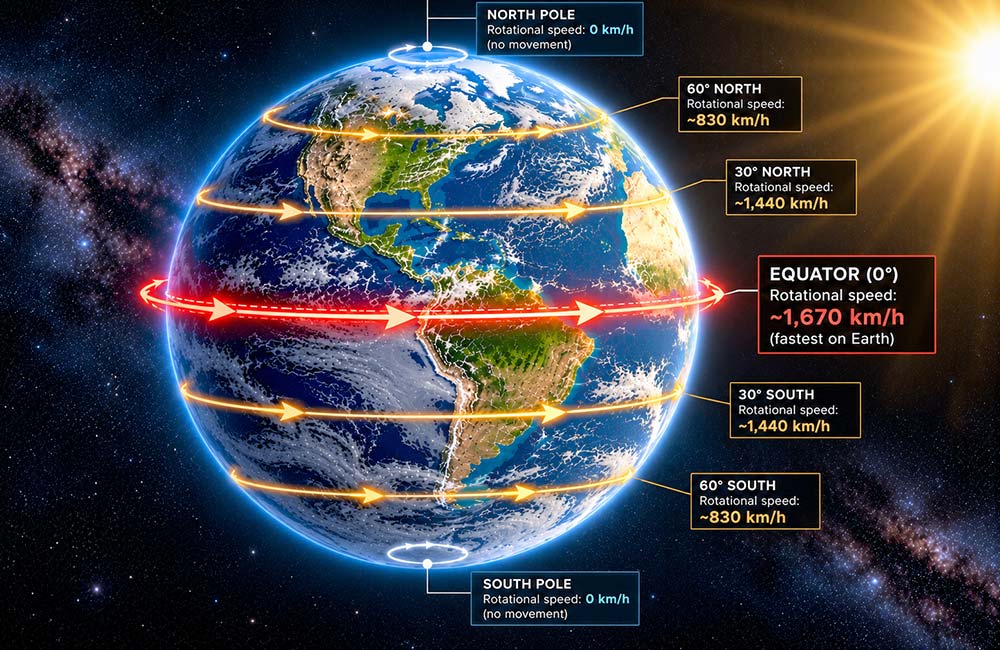
THE FIRST MOMENTS
What happens if the ground stops instantly?
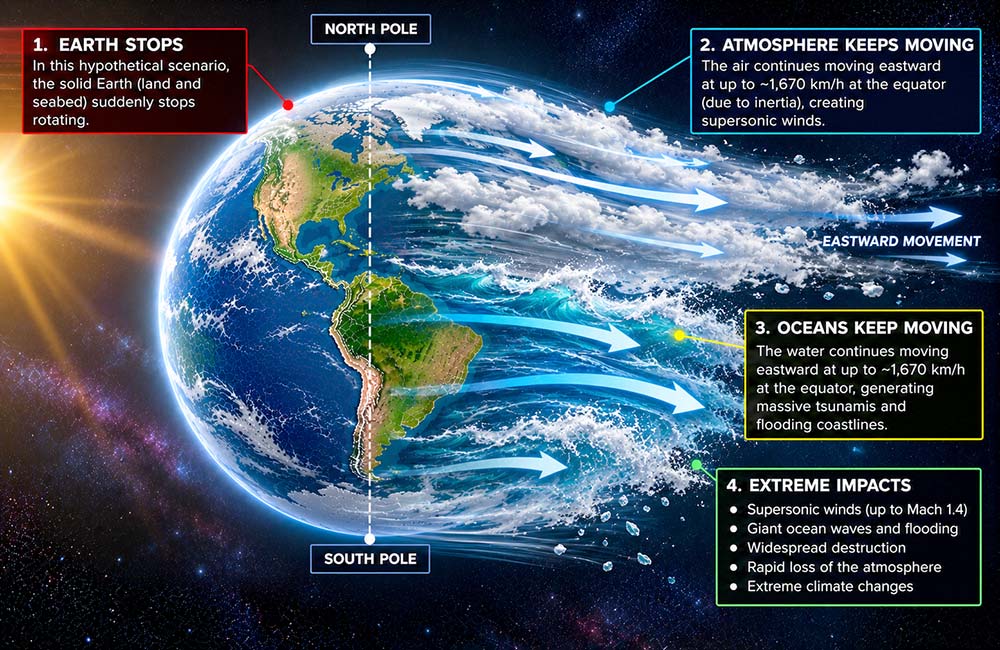
Stopping the solid Earth would not automatically stop everything else. Loose objects, air and water already share Earth's eastward rotational motion. In this thought experiment, that momentum becomes the immediate problem.
Momentum continues eastward
Loose objects and moving fluids retain their previous eastward velocity relative to the newly stationary ground.
The equator is hit hardest
The retained rotational speed is greatest near the equator and progressively smaller toward the poles.
Extreme relative winds
The atmosphere does not instantly lose its motion with the ground, creating destructive relative airflow.
Water keeps moving too
Ocean water retains momentum and would be violently redistributed across basins and coastlines.
AIR AND WATER
What happens to the atmosphere and oceans?
Earth's rotation helps shape large-scale atmospheric and ocean circulation through the Coriolis effect. In the sudden-stop thought experiment there is also the immediate momentum of air and water relative to the surface. Over longer times, without rotation, global circulation patterns would be fundamentally different.
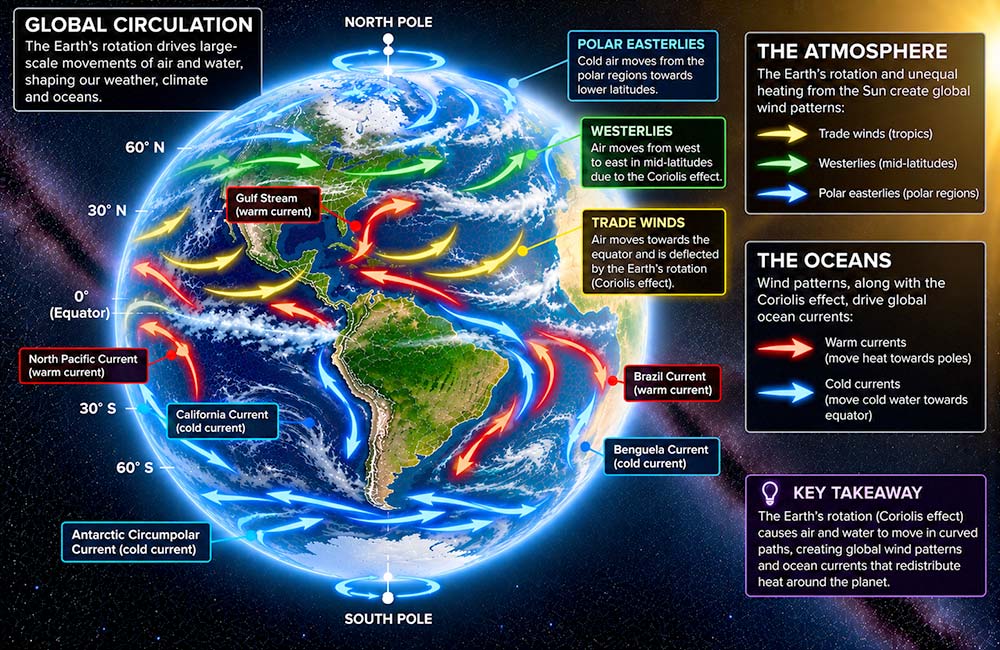
The first disaster comes from existing momentum. The later climate story is different: removing rotation also removes the familiar Coriolis deflection that helps organise today's wind and ocean patterns.
COMMON MISCONCEPTION
Would we be thrown into space?
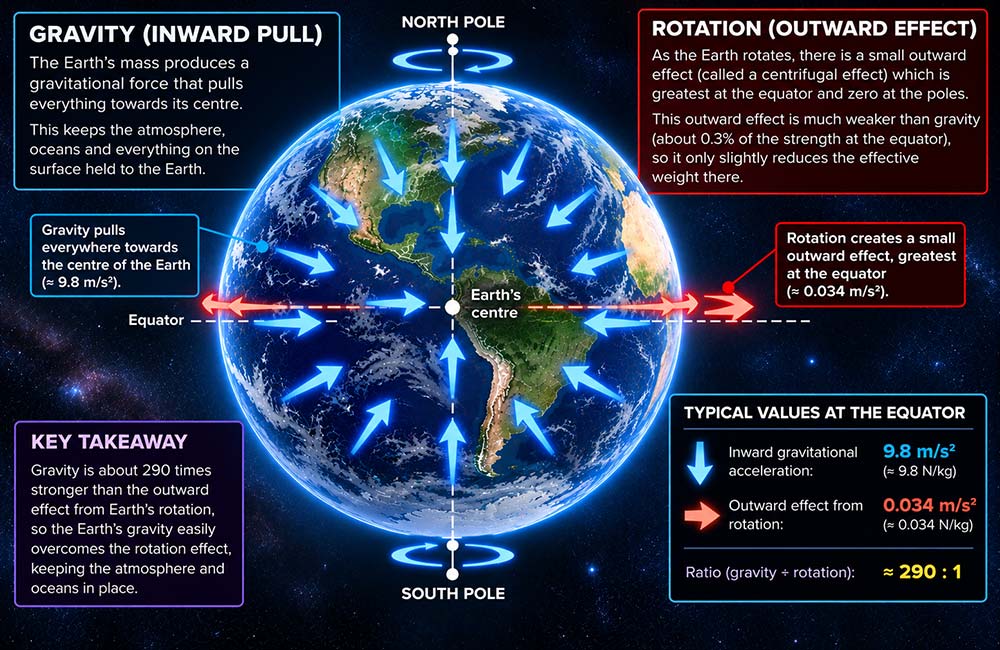
No — gravity does not switch off.
Earth's gravity comes overwhelmingly from its mass, not its rotation. A sudden stop would remove the small outward rotational effect, not Earth's gravitational attraction. The immediate danger is sideways momentum relative to the stopped surface.
A VERY DIFFERENT DAY
Would one side stay in daylight forever?
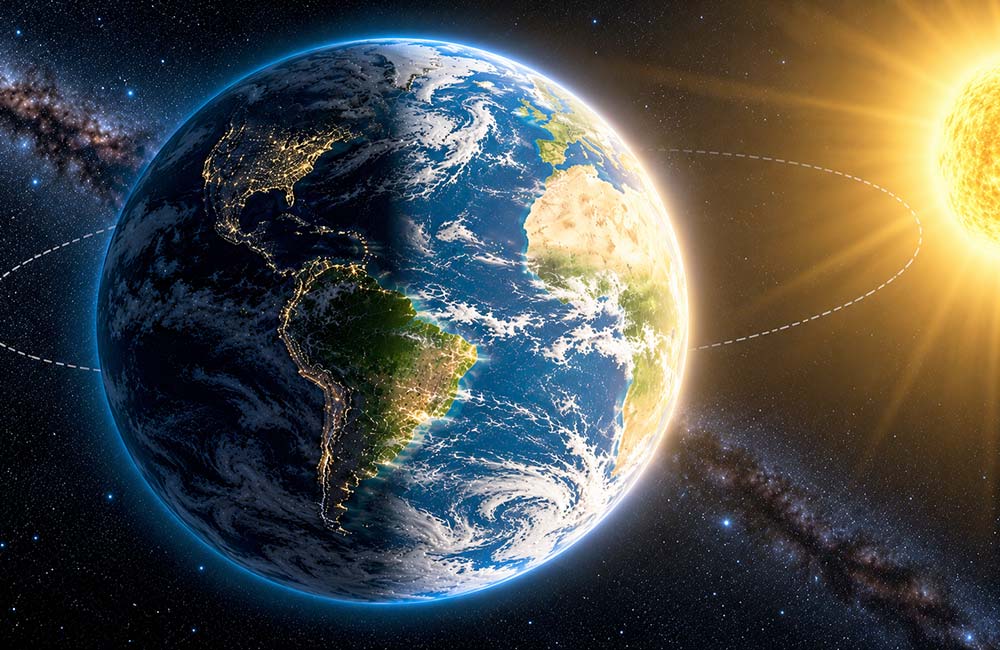
Not if Earth had zero axial rotation but continued orbiting the Sun. Permanent daylight on one fixed hemisphere would require a different state: synchronous or tidal locking. With no axial rotation and a continuing yearly orbit, the Sun would still move through the sky over the year, producing an extremely long solar day.
THE REAL-WORLD VERSION
Does Earth's rotation really change?
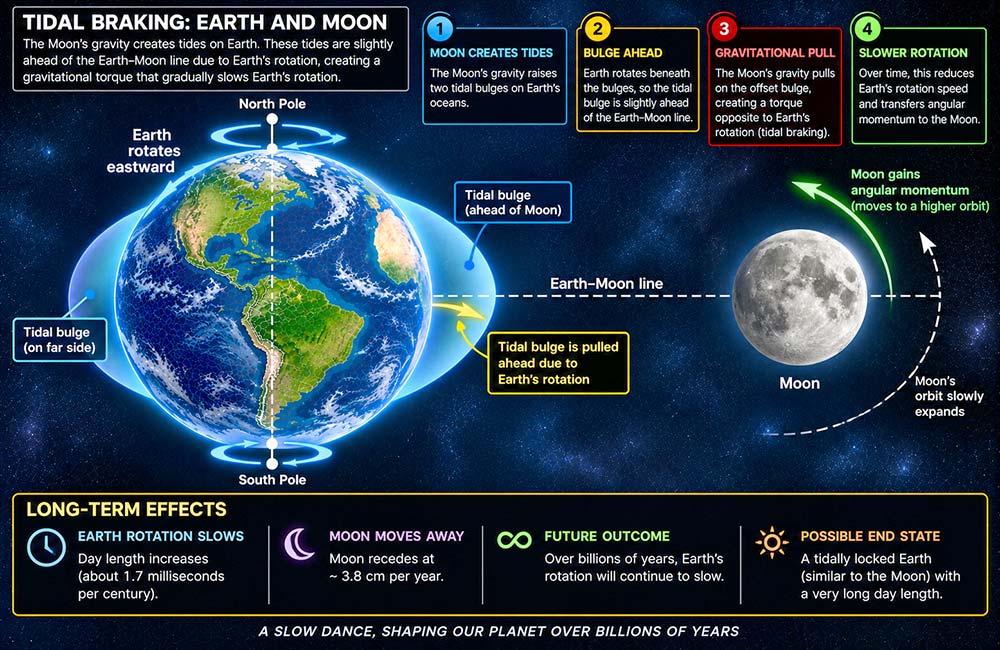
Yes. Earth's rotation is not perfectly uniform. Scientists measure small changes caused by exchanges of angular momentum among the solid Earth, atmosphere and oceans. Over geological time, tidal interaction with the Moon also changes Earth's rotation. These effects are tiny compared with the sudden-stop scenario.
SURVIVAL
Could anything survive?
In the instantaneous-stop scenario, survival would depend strongly on location and on the assumptions made about the impossible stopping mechanism. Places close to the rotational poles begin with much less eastward surface speed than the equator, but global atmospheric, oceanic and climatic disruption would still make this a planetary catastrophe.
Latitude changes the immediate momentum problem
Use the latitude comparison above: the closer a location is to a rotational pole, the lower its pre-stop eastward surface speed. That does not make the overall event safe; it changes only one part of the immediate hazard.
WHAT SCIENCE ACTUALLY SAYS
Why rotation matters to the real Earth
Earth's rotation gives us the familiar daily cycle and contributes to the Coriolis effect, which deflects large-scale moving air and water. Rotation also contributes to Earth's equatorial bulge. It is woven into the behaviour and shape of the planet even though we do not normally feel ourselves moving.
BOTTOM LINE
Earth stopping suddenly would be catastrophic — but it is not a realistic threat.
The key idea is momentum. The surface, atmosphere, oceans and everything on Earth currently share the planet's rotation. If the solid planet somehow stopped instantly while the rest retained that motion, the relative speeds would be devastating, especially near the equator. Gravity would remain, Earth would continue orbiting the Sun, and the long-term atmosphere and oceans would settle into patterns very different from today's rotating world.