

EXPLORE THE WHAT-IF
Turn down the world's bee pollination
Bees are not the only pollinators, and different crops depend on them to different degrees. This simplified simulator shows why losing bees would change the variety and reliability of our food supply more than it would eliminate food altogether.
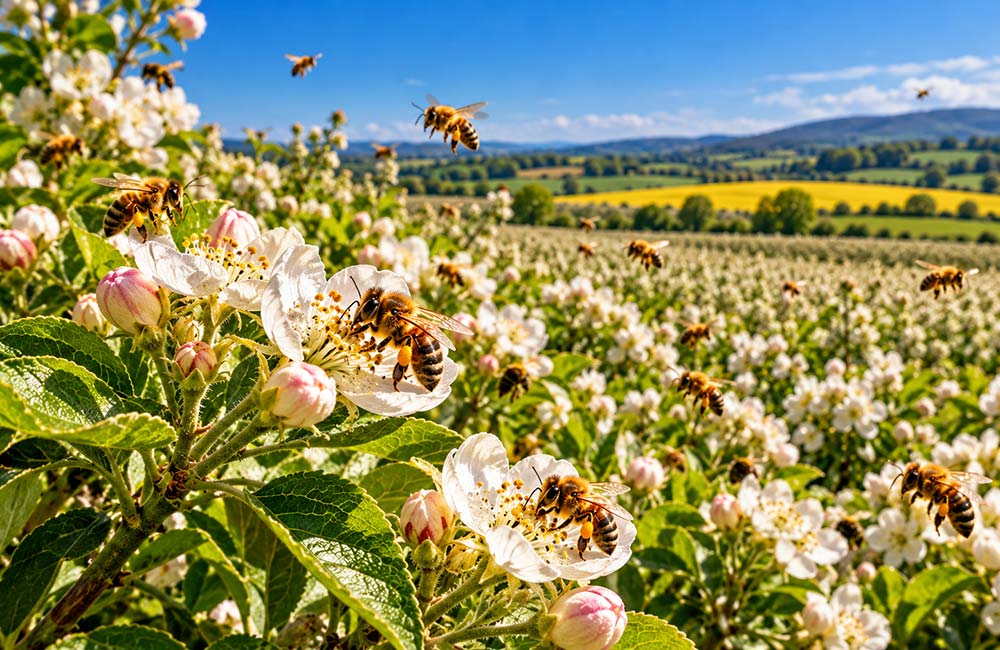
A diverse food system
With normal bee pollination, many fruit, nut, vegetable and seed crops receive the flower visits needed for reliable yields and good-quality produce.
Illustrative scenario only. Real crop responses differ by plant, location and the pollinators that remain.
THE FIRST EFFECTS
What would change first if bees disappeared?
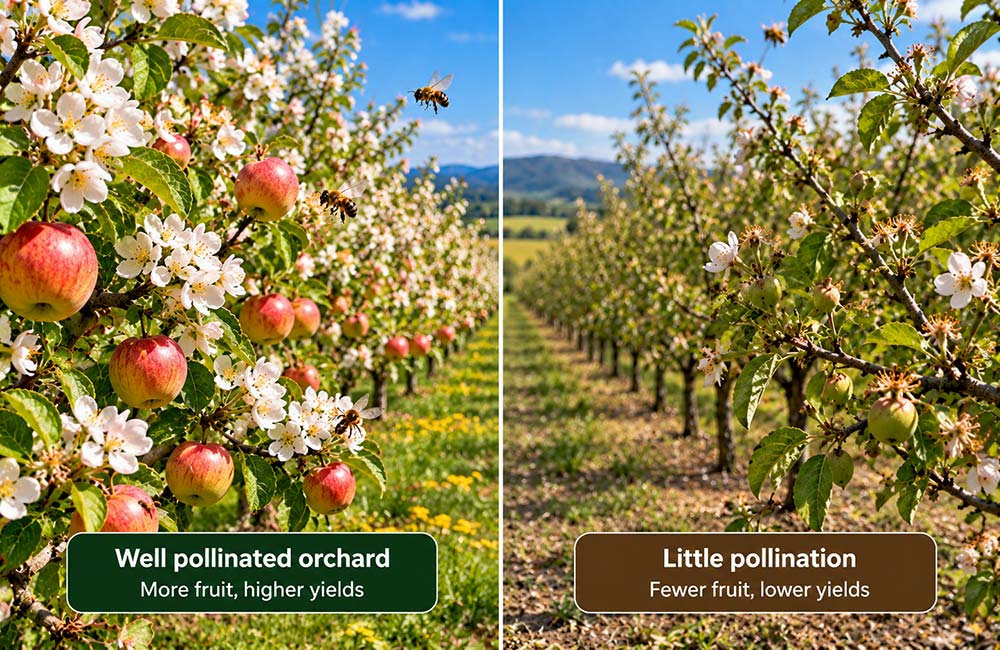
The first noticeable effects would appear wherever crops and wild plants rely heavily on bees to move pollen between flowers. Farmers would see poorer fruit set and lower yields in some orchards, berry fields, vegetable crops and seed-producing plants.
This would not look like supermarket shelves becoming empty on day one. Existing harvests, stored food and global trade would continue. The effect would build through future growing seasons as farms tried to produce the same crops with much less natural pollination.
YOUR FOOD
What foods would be affected most?
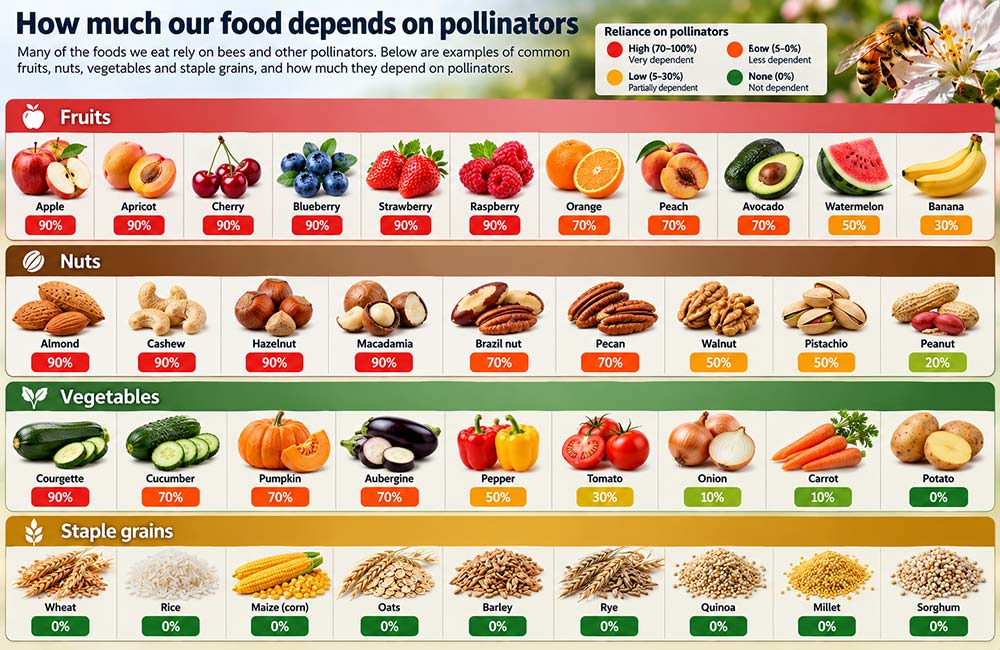
Bees are especially important to many crops that make diets varied and nutritious. Apples, berries, cherries, melons, squash, almonds and many other fruits, nuts and vegetables benefit from animal pollination. Coffee and cocoa also depend on animal pollinators, although bees are only part of a wider pollinator community.
The important distinction is that a crop can depend on pollination to some extent without disappearing completely when one pollinator group is lost. Some plants can self-pollinate, some use wind, and some can be visited by flies, moths, butterflies, beetles, birds or bats.
More vulnerable
Many fruits, nuts, berries, vegetables and seed crops would become harder to produce at today's scale.
Mixed impact
Some crops would still produce food but could have lower yields, poorer quality or greater production costs.
Less affected
Major wind-pollinated staples such as wheat, rice and corn would continue to grow.
A COMMON MYTH
Would humans run out of food without bees?
No. The claim that humans would immediately starve if bees vanished oversimplifies how agriculture works. Many of the world's calorie-producing staple crops are pollinated by wind or can reproduce without bee pollination.
What we would lose is resilience and diversity. A diet based more heavily on grains and other less pollinator-dependent crops could still provide calories, but many nutrient-rich fruits, nuts and vegetables would be scarcer or more expensive. The economic impact would also be substantial because farmers would have to adapt production methods while yields of some valuable crops fell.
It means fewer choices, pressure on pollinator-dependent crops, higher production costs and much larger ecological consequences beyond agriculture.
BEYOND THE FARM
The bigger story may be what happens to wild plants
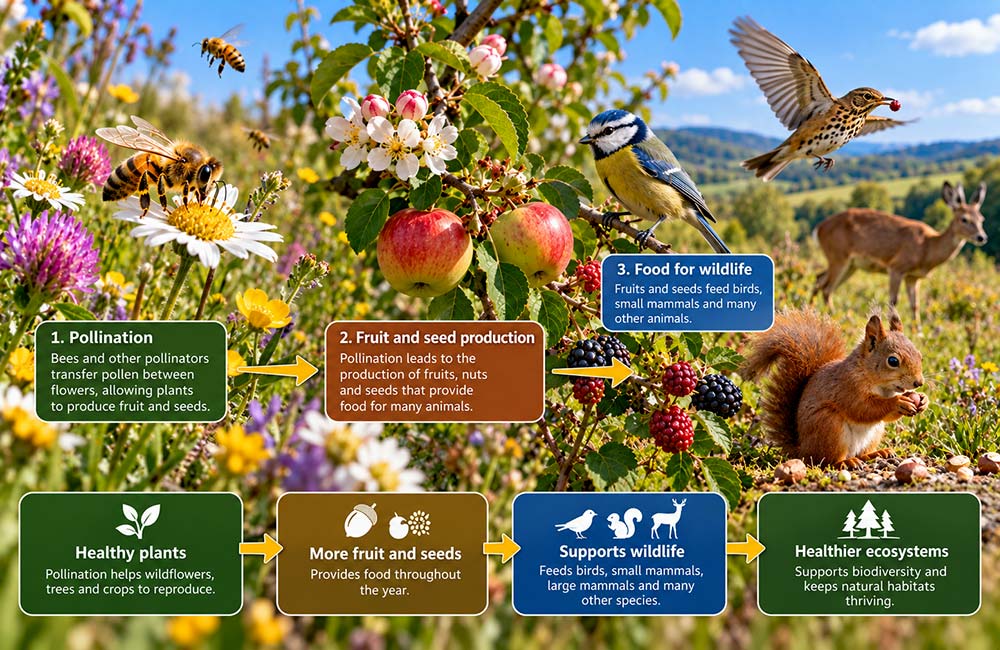
Bees pollinate far more than crops. They visit wildflowers, shrubs and trees across grasslands, forests, wetlands, deserts and gardens. When those plants successfully reproduce, they produce seeds and fruits that become food for other animals.
If bees disappeared, some wild plant populations would decline or become less genetically diverse. That change could ripple outward: fewer seeds and fruits for birds and mammals, altered plant communities, and less reliable habitat for insects and other wildlife.
Not every flowering plant would collapse. Other pollinators would continue working, and some plants reproduce without animal pollination. But removing thousands of bee species from ecosystems would erase a major network of relationships that evolved over millions of years.
WHO ELSE CAN POLLINATE?
Could butterflies, flies and other animals replace bees?
They could replace some of the lost pollination, but not perfectly. Butterflies, moths, flies, beetles, wasps, birds and bats all pollinate plants. Their importance varies enormously between ecosystems and crops.
Bees are unusually effective because adults deliberately collect pollen and nectar to feed themselves and their young. Their bodies often carry pollen efficiently between flowers, and many species repeatedly visit the same kind of flower during a foraging trip.
If bees vanished, surviving pollinators could become even more important. Farmers might encourage those species by creating habitat and reducing threats, but simply increasing butterfly or fly numbers would not recreate every ecological role performed by bees.
FARMING WITHOUT BEES
Could humans pollinate crops by hand?
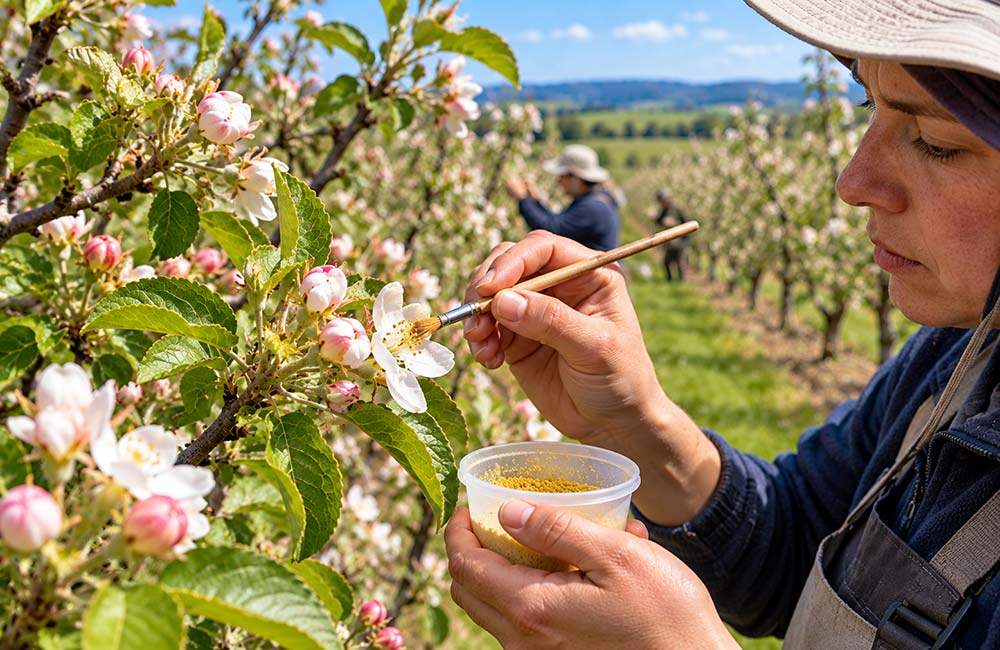
Hand pollination can work for certain high-value crops and is already used in some specialist situations. But replacing bees across vast orchards and fields would require enormous amounts of labour and would be impractical for many crops.
Technology could help. Growers might use mechanical pollen applicators, managed non-bee pollinators, carefully timed greenhouse systems or future robotic devices. Plant breeders could also favour varieties that depend less on animal pollination.
Those adaptations would come with costs. Pollination that ecosystems currently provide as a biological service would increasingly become something farmers had to manage and pay for directly.
HUMAN SURVIVAL
Would humans survive if bees went extinct?
Yes. Human extinction would not follow automatically from bee extinction. Staple crops, livestock and many other food sources would remain available, and agriculture would adapt.
But survival is a much lower bar than maintaining today's food system. Losing bees could make healthy diets more expensive, reduce the availability of some foods, damage farm economies and make ecosystems less stable. Regions already facing food insecurity could have less ability to absorb those additional pressures.
The ecological consequences would also continue even if humans found technological substitutes for crop pollination. A machine that pollinates an orchard does not replace a wild bee visiting thousands of plant species across natural habitats.
REAL-WORLD PRESSURES
Are bees actually going extinct?
There is no single global bee population that is simply counting down to zero. The world contains thousands of bee species, from managed honey bees to wild bumble bees and solitary bees, and their populations do not all follow the same trend.
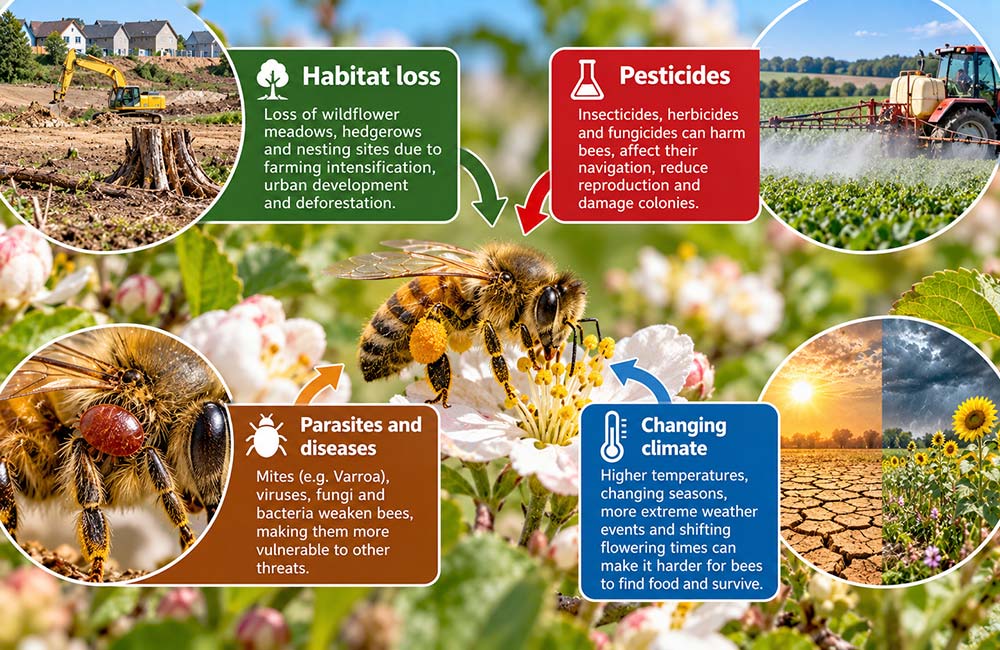
However, many pollinators face combinations of habitat loss and degradation, parasites and disease, pesticide exposure, reduced flower diversity and climate change. A species can decline sharply in one region while another remains common or even expands elsewhere.
That is why the realistic concern is not that every bee suddenly disappears on the same day. It is the gradual loss of species, abundance and pollination services in places where plants and people rely on them.
COULD WE REVERSE IT?
Could bees come back after a major decline?
A declining bee population can recover if enough individuals survive and the conditions causing the decline improve. Restoring flowering habitat, protecting nesting sites, managing pests and disease, and reducing harmful exposures can all form part of pollinator conservation.
Extinction is different. Once a species is truly extinct, it cannot naturally return. Other species may occupy some of its ecological role, but that does not recreate the lost species or all of the relationships it had with local plants.
This is one reason protecting a diverse community of wild and managed pollinators matters. Diversity provides ecological backup: different species work at different temperatures, visit different flowers and thrive in different landscapes.
WHAT SCIENCE ACTUALLY SAYS
Bees matter enormously — but they are part of a bigger pollination system
Global assessments consistently show that a large share of flowering plants and crop types benefit from animal pollination. That does not mean the same share of human calories would disappear, because many major staple crops are wind-pollinated or otherwise less dependent on animal pollinators.
The safest way to describe a bee-free world is therefore not “humans would have no food.” It is a world with reduced crop diversity, more difficult production of many fruits, nuts and vegetables, economic disruption, and widespread changes to wild plant communities.
Sources for the figures and scientific framing on this page include the UN Food and Agriculture Organization (FAO) and the U.S. Department of Agriculture (USDA/NRCS).
BOTTOM LINE
If bees vanished, we would notice it on our plates — but the deepest effects would spread through ecosystems.
Wheat, rice and other staples would not suddenly disappear, so humans would not immediately starve. The harder losses would be many of the foods that make diets diverse, alongside the wild plants that depend on bees to reproduce. Other pollinators and technology could soften some agricultural effects, but they could not simply replace thousands of bee species and their ecological relationships.