

EXPLORE THE WHAT-IF
Change the size of the asteroid
There is no single answer to an asteroid impact. A small rocky object and a 10-kilometre asteroid are completely different hazards. Use the control below to compare broad impact scales based on NASA planetary-defence guidance.
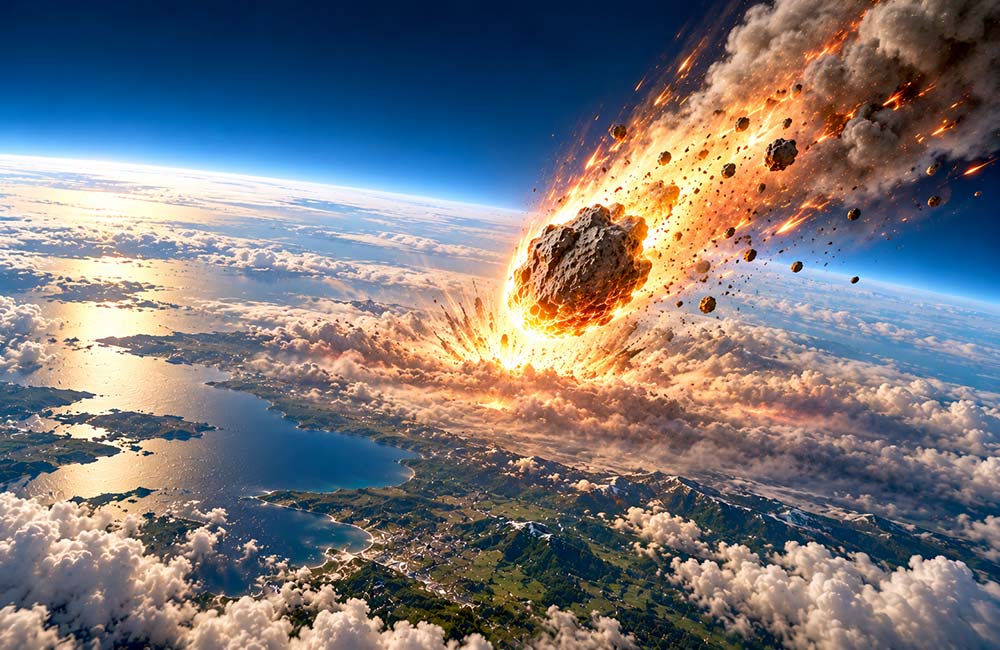
Severe damage across a large populated area
An object around this scale could survive atmospheric entry strongly enough to produce a destructive blast and, depending on its properties, an impact crater. The exact damage footprint would depend on speed, density, angle and location.
A land impact concentrates blast, thermal effects and ground damage around the impact region.
Illustrative scale comparison only. Real outcomes depend on asteroid composition, velocity, entry angle, breakup and impact location.
BEFORE IMPACT
First, it has to get through the atmosphere
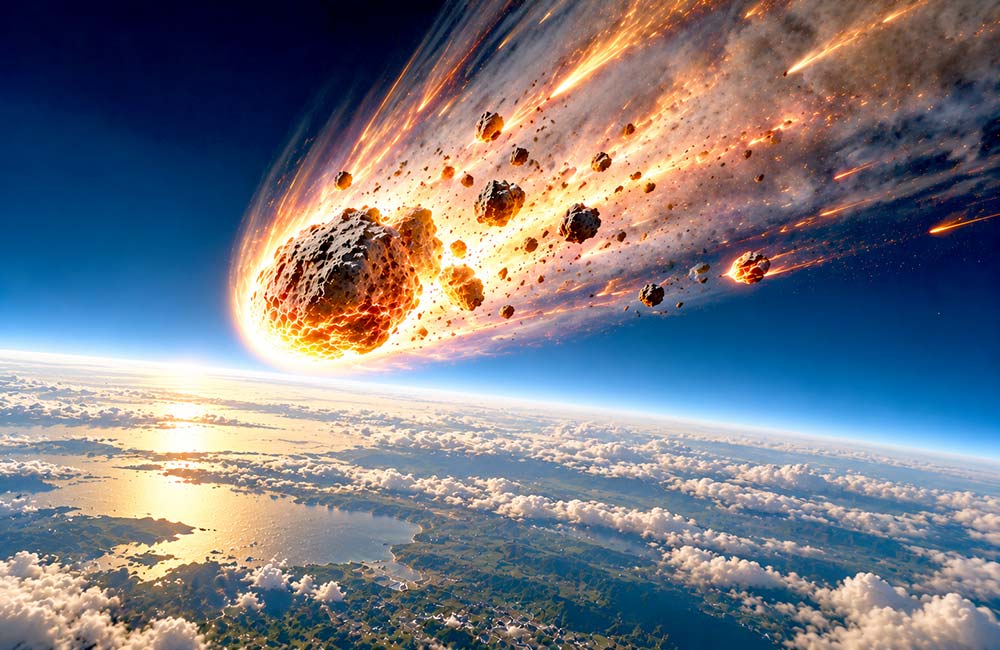
Earth's atmosphere is an important shield. Tiny meteoroids are slowed and destroyed high above the ground, producing the streaks of light we call meteors. Even larger rocky objects can fragment as enormous aerodynamic forces build during entry.
That does not always make the event harmless. When a larger object breaks apart rapidly, much of its kinetic energy can be released into the atmosphere as an airburst. The 2013 Chelyabinsk event showed how a space rock can damage buildings and injure people without excavating a major crater.
NASA says objects smaller than roughly 25 metres will most likely burn up in the atmosphere and cause little or no ground damage. Above that scale, the consequences begin to increase quickly, although size alone never tells the whole story.
ZERO HOUR
What happens in the first seconds of a major impact?
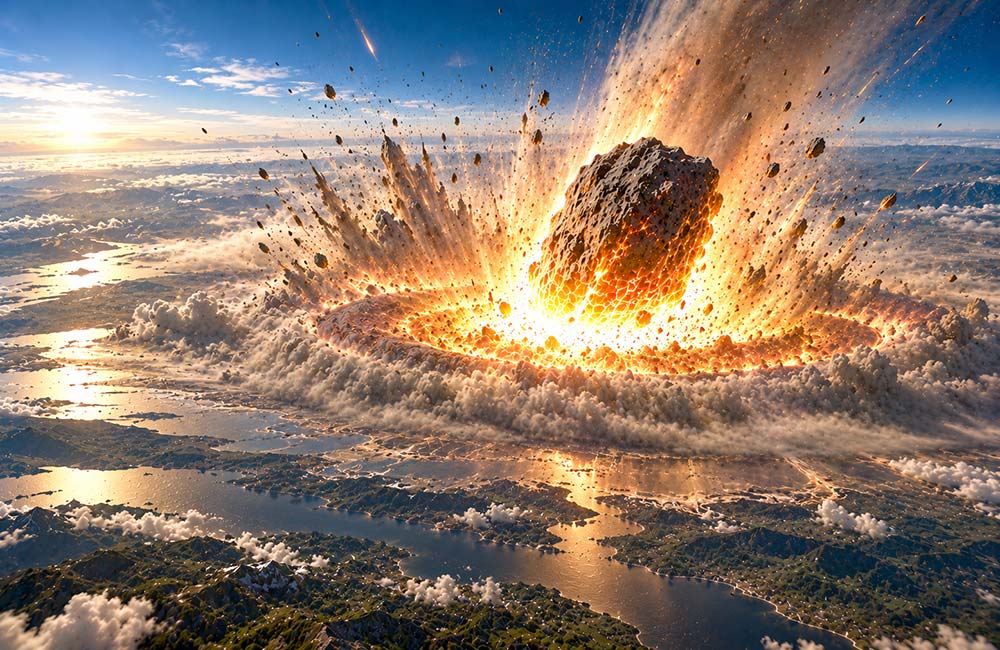
A large asteroid arrives at many kilometres per second. Its kinetic energy is converted almost instantly into heat, shock waves, excavation of the ground and motion of shattered rock. At the impact point, both the asteroid and part of the target can be vaporised or melted.
A crater forms as material is driven downward and outward. Rock and debris are thrown into the air, while an intense blast wave travels away from the impact site. Close enough to a sufficiently large impact, thermal radiation can ignite materials and the pressure wave can destroy structures.
The crater is only one part of the hazard. For large impacts, material lofted high into the atmosphere can spread far beyond the impact region. At the extreme end of the scale, those atmospheric effects become more important than the crater itself.
SIZE CHANGES EVERYTHING
From a bright fireball to a global catastrophe
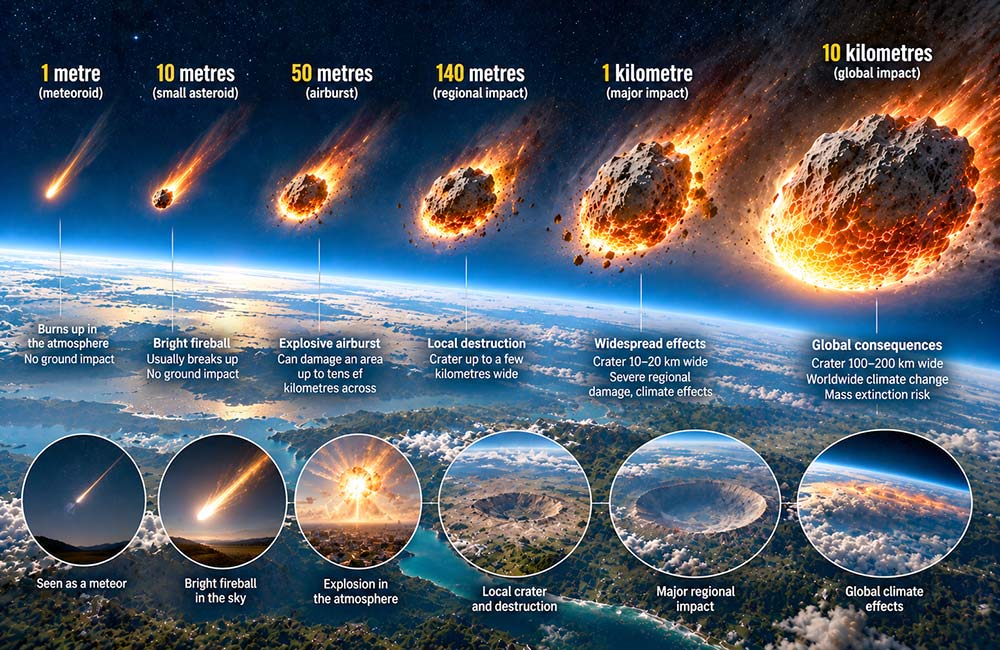
NASA's published hazard scale gives a useful sense of how rapidly the consequences increase. Objects around 10 metres across can produce brilliant fireballs and sonic booms. Around 50 metres, local devastation becomes possible. Around 140 metres, an impact could threaten a metropolitan or wider region depending on where it occurs.
At roughly one kilometre, the problem changes from primarily local or regional destruction to possible worldwide effects. Dust, aerosols and other material injected into the atmosphere could alter sunlight and climate, disrupting agriculture far from the crater.
A roughly 10-kilometre object belongs to another category again. Impacts of that scale are extraordinarily rare, but Earth's geological record shows that they can cause environmental disruption on a planetary scale.
Fireball, sonic boom and possible window damage.
Airburst or impact capable of severe local destruction.
Potentially devastating across a populated region.
Worldwide environmental and societal consequences become possible.
Planet-wide climate and ecosystem disruption.
WHERE IT HITS
Would an ocean impact be safer than a land impact?
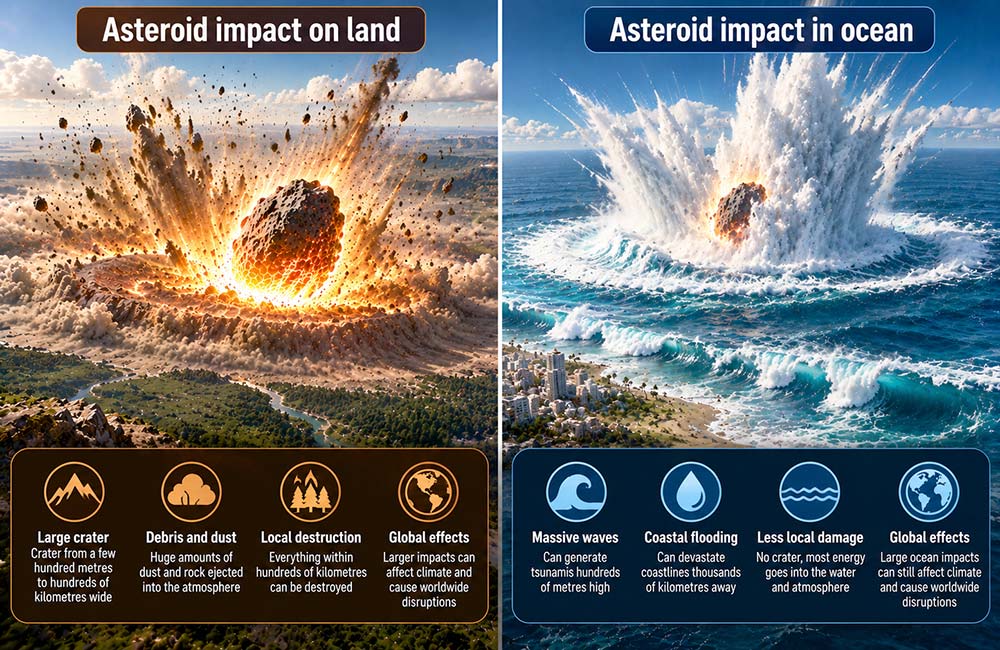
Not necessarily. An ocean impact changes the mix of hazards rather than simply removing them. A sufficiently large object can displace water and generate dangerous waves, especially for nearby coastlines. The details depend on asteroid size, water depth, distance from shore and the geometry of the impact.
On land, the most obvious hazards are blast, heat, crater formation and ejecta. In the ocean, some of the asteroid's energy goes into the water and atmosphere. Smaller airbursting objects may produce little significant tsunami, while larger impactors can create serious coastal hazards.
For the very largest impactors, the distinction matters less to the global outcome. Enough energy and material can be injected into the atmosphere that effects extend far beyond the ocean basin or continent where the collision occurred.
AFTER THE IMPACT
What happens in the hours, months and years afterwards?
The immediate impact region experiences the most violent mechanical and thermal effects.
Shock waves, fires, falling debris and — for some ocean impacts — coastal waves can extend the disaster.
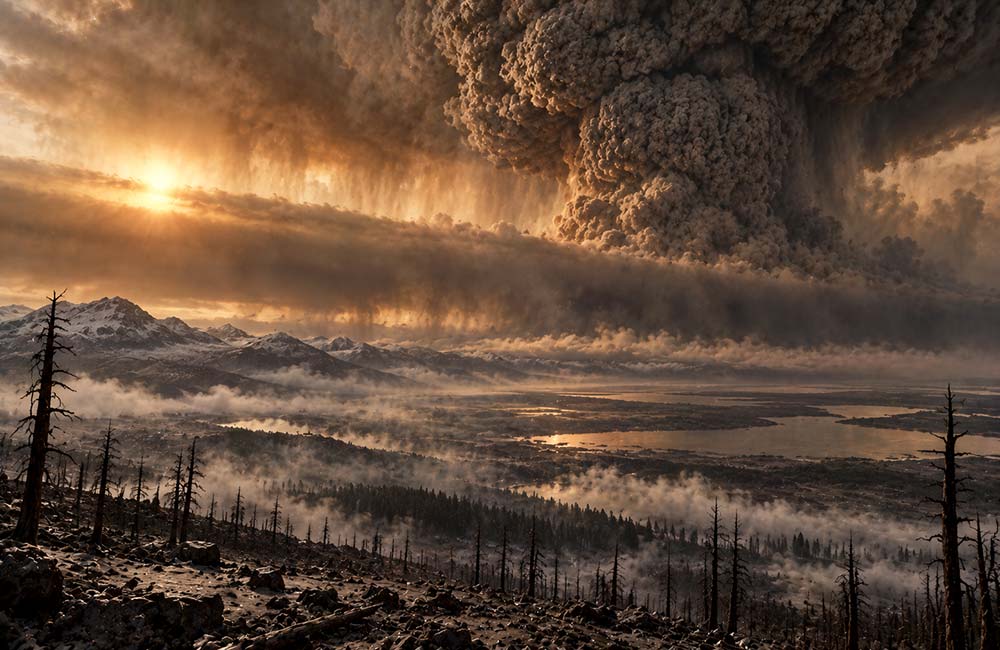
For sufficiently large impacts, dust and aerosols can reduce sunlight and disturb weather and climate.
Reduced sunlight and climate disruption can damage plant growth, agriculture and ecosystems far from the crater.
A local event can be rebuilt after; a giant impact can permanently reshape ecosystems and the course of life.
THE DINOSAUR QUESTION
Could an asteroid impact wipe out humanity?
A small or medium asteroid would not make humanity extinct. Even a devastating regional impact would leave most of the planet physically untouched. The extinction question becomes meaningful only for exceptionally large objects capable of disrupting the global environment.
The Chicxulub impact about 66 million years ago is the famous example. The impactor is estimated to have been roughly 10 kilometres across and is associated with the end-Cretaceous mass extinction. The catastrophe was not simply a giant explosion: atmospheric dust and aerosols, darkness, cooling, fires and collapsing food webs turned the impact into a planetary ecological crisis.
That history shows that an asteroid can trigger mass extinction. It does not mean every large impact would automatically eliminate humans. Human survival would depend on impact size, environmental effects, food production, infrastructure and the ability of surviving populations to endure a prolonged global crisis.
The overwhelming majority of incoming space material is harmless. Extinction-scale impacts sit at the extreme, exceptionally rare end of the asteroid hazard spectrum.
HOW RARE IS IT?
The more destructive the asteroid, the rarer the event
Earth encounters small material constantly. NASA estimates that automobile-sized objects enter the atmosphere roughly once a year and usually burn up. Objects around 50 metres across are much less frequent, while kilometre-scale impacts occur on geological timescales.
NASA's current hazard summary estimates an impact around 140 metres in diameter roughly once every 20,000 years, a one-kilometre impact around once every 700,000 years, and a roughly 10-kilometre impact around once every 100 million years. These are long-term statistical averages, not schedules.
Most importantly, NASA reports that there is currently no known asteroid larger than 140 metres with a significant chance of striking Earth during the next 100 years. Astronomers continue searching because finding a dangerous object early is what makes prevention possible.
PLANETARY DEFENCE
Could we stop an asteroid before it hits?
Potentially — if we discover it early enough. Unlike earthquakes or hurricanes, an asteroid impact is a natural disaster whose source can in principle be moved before it reaches Earth.
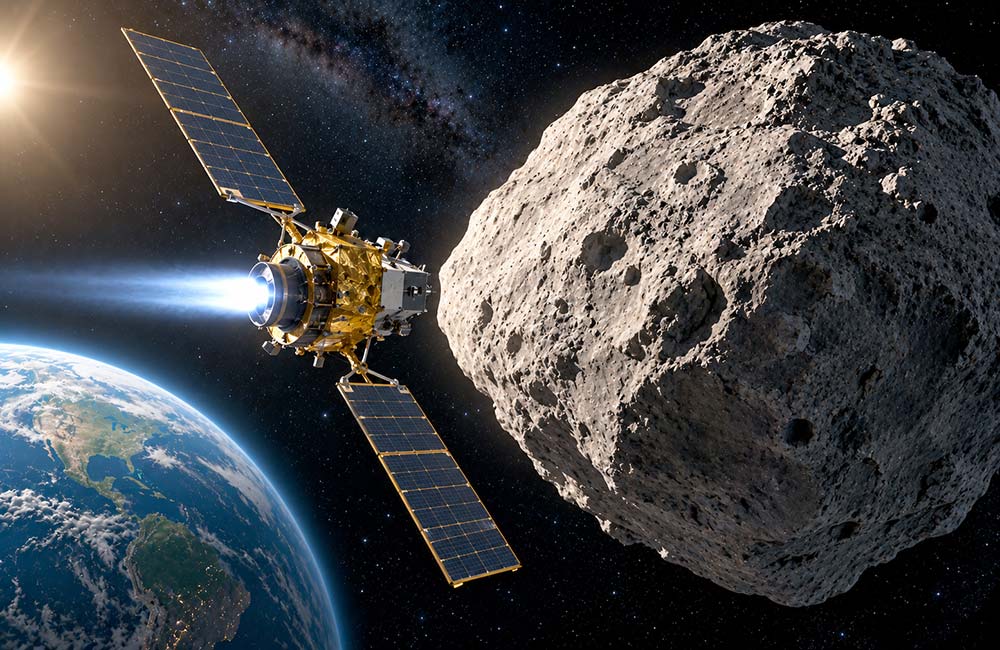
NASA's planetary-defence work focuses first on discovering near-Earth objects, measuring their orbits and determining whether any pose an impact risk. If a dangerous asteroid were identified years or decades ahead of time, a spacecraft could potentially alter its orbit by a tiny amount that grows into a safe miss by the time it reaches Earth.
NASA's DART mission demonstrated this principle in 2022 by intentionally striking Dimorphos, the moonlet of asteroid Didymos, and changing its orbital period. DART was a test, not a response to a threatening asteroid, but it showed that kinetic-impact deflection is a real technique rather than just a theoretical idea.
WHAT SCIENCE ACTUALLY SAYS
There is no known civilization-ending asteroid heading for Earth
Asteroid impacts are real geological events, but dramatic fictional scenarios can distort the actual risk. Scientists track near-Earth objects precisely because the consequences of a rare large impact could be serious.
NASA's Center for Near Earth Object Studies calculates asteroid and comet orbits and assesses potential impacts. NASA's Planetary Defense Coordination Office coordinates detection, tracking and response planning. Current NASA guidance says no known asteroid larger than 140 metres has a significant chance of impacting Earth in the next century.
Predictions also improve as observations accumulate. A newly discovered asteroid can initially have a small non-zero impact probability because its orbit is not yet known precisely. Additional observations usually shrink that uncertainty and can remove the apparent threat entirely.
This thought experiment uses broad hazard ranges and planetary-defence information from NASA, NASA/JPL CNEOS and the U.S. Geological Survey. Exact damage cannot be inferred from diameter alone.
Scientific information checked October 2026.
BOTTOM LINE
What happens if an asteroid hits Earth?
For most incoming space rocks, very little. Small objects burn up or break apart. As asteroid size rises, the outcome progresses from atmospheric fireball to local destruction, regional catastrophe and — only at the extreme end — global climate and ecosystem disruption. A dinosaur-scale impact is possible in nature, but it is extraordinarily rare, and modern astronomy gives humanity something previous species never had: the ability to search for a threat in advance and potentially deflect it.